When you are choosing castors for a trolley, it is easy to focus on wheel diameter, material and load capacity. While these are all important, the position of the castors beneath the trolley can have just as much influence on how safely and comfortably it moves.
If you place your castors correctly, it helps distribute the load, keeps the trolley balanced and gives the operator predictable control. If the castors are placed poorly, an otherwise well-built trolley can feel unstable and difficult to steer, which can make it easy to tip.
If you are buying a new trolley or replacing existing wheels, understanding the basic principles of castor placement can help you choose a safer and more practical arrangement.
Why Castor Placement Matters
The weight of the trolley and its contents is balanced in its centre of gravity.
To keep the movement of the trolley stable, the centre of gravity should remain inside the area supported by the castors. The wider and longer the supported area is, the more resistant the trolley will be to tipping.
If you place castors close to the outer corners, it creates a broad support base. This is preferable for tall equipment, heavy loads and trolleys that may be pushed around bends. A trolley will have a narrower effective footprint if the castors are mounted too far inwards. This can make it feel unstable and reduce the operator’s control.
Common Castor Configurations
Depending on how your trolley will be used, there are different castor arrangements.
If you are working in confined spaces, workshops or retail environments, four swivel castors may be the best choice for your trolley. This configuration allows the trolley to move in any direction. However, these trolleys can be harder to keep travelling in a straight line because all the wheels swivel freely.
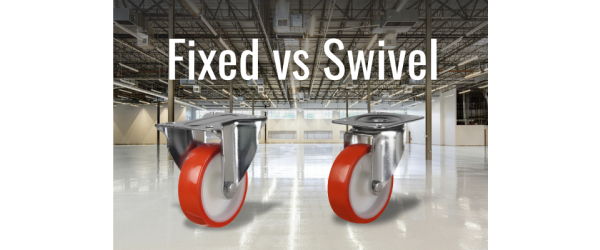
A combination of two fixed castors and two swivel castors is a popular choice for warehouses and industrial environments. The swivel castors provide controlled steering, while the fixed castors help the trolley track straight. This arrangement is preferred for heavier loads and longer travel distances because it strikes a balance between manoeuvrability and stability.
Occasionally, a diamond configuration is used to improve manoeuvrability on long trolleys, where one swivel castor is positioned at each end, with fixed castors mounted centrally. This arrangement requires careful load calculations to make sure the weight is properly supported.
Why Different Trolleys Use Different Castor Layouts
If you look at different types of trolleys, you will notice that their castors aren’t always mounted in the same position.
Platform trolleys typically have castors positioned close to each corner to create the widest possible base. Service trolleys and catering trolleys sometimes position castors slightly further inboard to reduce the risk of accidental impacts in busy environments. Mobile workbenches and machinery bases may use reinforced mounting positions that suit the construction of the frame rather than the overall size of the platform.
Load Position and Weight Distribution
To make sure your trolley moves effectively, you need to think about the load position together with the castor placement. Even if the castors are fitted correctly and positioned appropriately, a trolley can still become unstable if the weight isn’t evenly distributed or stacked too high.
To keep the centre of gravity within the area supported by the castors, heavy items should be positioned low and as close to the centre of the trolley as possible. This reduces the risk of tipping.
Each castor will not always carry exactly the same amount of weight due to uneven floors or off-centre loads. It is important to choose castors with a suitable safety margin in their load capacity to keep the trolley stable and reliable during everyday use.
Choosing the Right Castor Placement
The best castor placement depends on the trolley’s size, load and working environment.
For the majority of industrial and commercial applications, positioning castors close to the outer corners gives you the greatest stability and support. However, if you are fitting castors to a trolley that is more specialist, you may benefit from alternative layouts.
If you are struggling to work out which arrangement would be best for your application, our team can help you select the right combination of castors to make sure your trolley performs safely and efficiently.