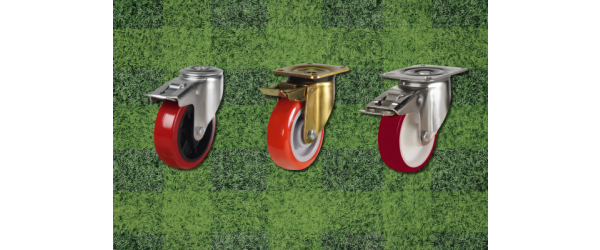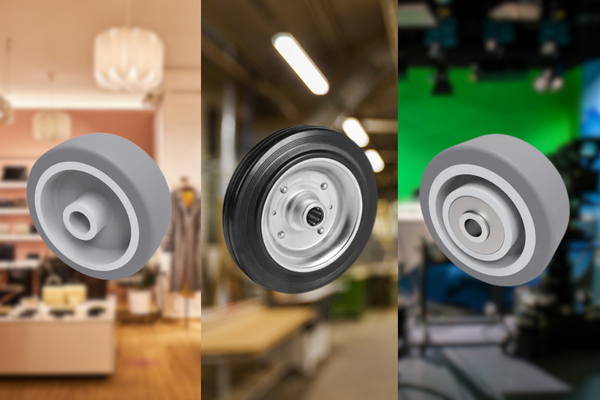
There are many different features that make up a castor wheel and determine if it is suitable for your application such as material, wheel size and load capacity. There is another important factor you should consider when choosing castors, the bearing inside the wheel.
The bearing sits at the centre of the wheel and allows it to rotate around the axle. Depending on the bearing type, wheels can move differently and are more suitable for different use cases.
Three of the most common options are plain bore, roller bearing and ball bearing wheels. Each of these options has their own benefits, so knowing the differences can help you choose the right castor for the job.
Plain Bore Wheels
One of the simplest types of wheels is plain bore wheels. The axle or bolt passes through the centre of the wheel, allowing the wheel to rotate directly around it.
Plain bore wheels are often a practical and economical choice for lighter-duty applications because of the simple design. They work well for equipment that is only being moved occasionally or over short distances.
Typical uses include:
- Furniture
- Display stands
- Light trolleys
- Bins and waste containers
- Shop fittings and retail equipment
The main drawback of plain bore wheels is that there is more friction between the wheel and axle than with a roller or ball bearing. Equipment can become harder to push as the load gets heavier or if it is being moved more frequently.
If you are looking for something simple and reliable for lighter applications, a plain bore wheel can be the way to go.
Roller Bearing Wheels
Roller bearings are designed to reduce friction by using a series of small rollers between the wheel and the axle.
This design can make equipment easier to move, especially when carrying heavier loads, compared with a plain bore design.
Roller bearing wheels are commonly used for:
- Workshop trolleys
- Warehouse equipment
- Stock picking trolleys
- Material handling carts
- Equipment stands
- Equipment that is moved more regularly throughout the day
They are often a good middle ground between a simple plain bore and a ball bearing.
Ball Bearing Wheels
Ball bearing wheels use small balls inside the bearing to help the wheel rotate smoothly around the axle.
If you are using equipment that needs to be moved regularly or carries heavier loads, the design of ball bearing wheels can help reduce friction and make movement easier.
Ball bearing wheels are often used for:
- Heavy-duty platform trolleys
- Stage, TV and film equipment
- Machinery and equipment bases
- Industrial carts and material handling equipment
- Mobile workstations
- Equipment that needs frequent or precise repositioning
Ball bearings may not automatically be the best choice for every application. If your equipment is light and is only moved occasionally, a simpler bearing may be more than adequate.
Other Things to Consider
The bearing itself is only one part to consider when choosing the correct castor.
You should consider wheel diameter as it also affects how easily equipment rolls. Larger wheels generally perform better than smaller wheels when moving over small obstacles or uneven surfaces.
Another important aspect to consider is wheel material. Rubber, polyurethane, nylon and other materials all behave differently and work better on different floor types, so it’s a good idea to check what material works best in your environment.
Calculating the total load of your equipment is particularly important as overloading your castors can cause them to become faulty. You need to make sure you are calculating the load including any goods being carried, not just the equipment itself.
How often you are using your equipment matters too. A trolley that is being used constantly will have different requirements from one being moved once or twice a week.
Keeping Your Equipment Moving
Plain bore, roller bearing and ball bearing wheels all have their place.
Plain bore wheels offer simplicity for lighter use.
Roller bearings provide easier movement for regular applications.
Ball bearings offer smooth performance when movement is frequent or loads are heavier.
If you are still unsure about what would work best for your application, our team can help you select the best castors for the job to make sure they perform safely and efficiently.